
The Competition
Psalm 23

Reading Time: 5 min
When I was ten years old, I lived in a very small town in Arkansas. Counting me, exactly 102 people lived there. I once asked my Dad why the population never seemed to change. His answer was simple and delivered without a smile. “Every time a baby is born, a man leaves town.” Since he was my Dad, and since I was ten, I accepted this as solid census logic and never questioned it.
For a town that small, we had a surprising number of churches. There were four of them, and while we were friendly with one another, there was also a quiet sense of competition. Each church was confident it had the clearest understanding of heaven. We were reasonably sure we were all going there, though we sometimes wondered about the folks over at the Church of Christ. To be polite, we kept those thoughts to ourselves.
Now that I have wandered down that memory lane, let me return to the point.
That year, all four churches joined forces to host a Scripture Memorization Competition. There were only seven kids my age in town, so the field was not exactly crowded. Each of us could choose any Bible passage we wanted and recite it in front of a panel of judges. The child who memorized the most verses would win a silver trophy with their name engraved on it. That trophy might as well have been Olympic gold.
The first contestant was LeRoy Johnson. He stood up proudly and said, “My verse is John 11:35. Jesus wept.” It was short, accurate, and hard to beat for efficiency. A few others followed with one or two verses of their own. Then it was my turn.
I stood up and announced, “My scripture is the entire Psalm 23, all six verses. It begins with The Lord is my shepherd, I shall not want, and it ends with I shall dwell in the house of the Lord forever.”
The trophy was mine. My name was engraved. My Mama was convinced she was raising the next Billy Graham. I kept that trophy for forty years until it disappeared during a move from somewhere to somewhere else, as so many things do.
The trophy is gone, but something far more important stayed with me. Eighty-six years later, Psalm 23 still lives clearly in my aging memory. So I invite you to grab a Bible, find a comfortable chair, and for a few minutes, let me be that ten-year-old kid again as we walk through this psalm together.
Psalm 23 is one of the most loved and recognized passages in the Bible. It is short, simple, and deeply powerful. Written by King David, a former shepherd himself, this psalm speaks to the human heart in times of peace, fear, loss, and hope. Its enduring message is that God is not distant or uncaring. He is present, attentive, and faithful, guiding His people through every season of life.
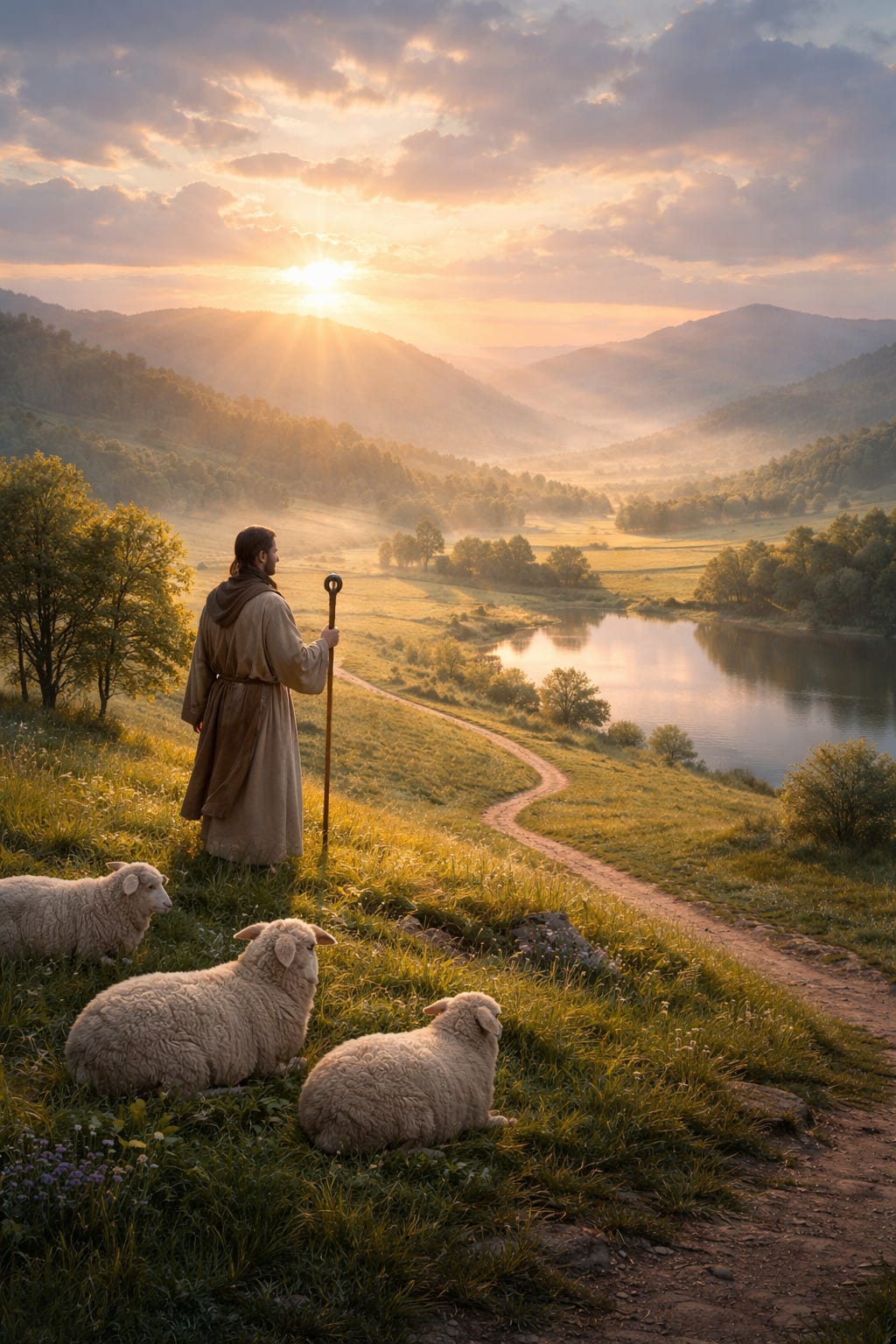
The psalm opens with one of the most comforting statements in Scripture, “The Lord is my shepherd, I shall not want.” With these words, David declares a personal relationship with God. God is not just a shepherd; He is my shepherd. A shepherd knows his sheep, watches over them, and provides for their needs. Because the Lord fills this role, David is confident that nothing essential will be missing from his life. This does not mean life will be easy or free from hardship, but it does mean that God will supply what is truly needed.
David continues by describing green pastures and still waters. These images represent rest, peace, and renewal. Sheep cannot find such places on their own, they must be led there. In the same way, people often rush through life, burdened by stress, fear, and responsibility. Psalm 23 reminds us that God invites us to slow down and trust Him. He restores our souls, not only when we are physically tired, but when we are emotionally and spiritually worn down.
The psalm then turns toward guidance and purpose. “He leads me in paths of righteousness for his name’s sake.” God does not lead randomly or carelessly. He leads with intention, shaping our lives in ways that reflect His goodness and character. Even when we do not understand where the path is leading, we can trust the One who walks ahead of us. Our lives gain meaning when they are aligned with God’s direction rather than our own uncertain plans.
One of the most powerful moments in Psalm 23 comes with the words, “Even though I walk through the valley of the shadow of death, I will fear no evil.” This verse acknowledges a reality everyone faces. Life includes valleys, seasons of loss, illness, grief, and fear. Faith does not remove these valleys, but it changes how we walk through them. David does not say he will avoid the valley; he says he will walk through it. The journey continues because God is present.
The comfort comes from God’s presence and protection. “Your rod and your staff, they comfort me.” The rod was used to defend the sheep, and the staff was used to guide them. Together, they represent both protection and care. God does not abandon His people in difficult moments. He stands watch, ready to defend, correct, and guide.
The psalm closes with an image of abundance and belonging. God prepares a table in the presence of enemies, anoints the head with oil, and fills the cup until it overflows. These words speak of honor, care, and blessing, even in the midst of opposition. They remind us that God’s goodness is not fragile. It remains strong no matter what surrounds us.
Psalm 23 ends with a promise that reaches beyond this life. “Surely goodness and mercy shall follow me all the days of my life, and I shall dwell in the house of the Lord forever.” This is a statement of hope and assurance. God’s love does not fade with time. It follows, surrounds, and sustains us now and forever.
Psalm 23 teaches us that we are never alone. We are known, guided, protected, and loved by a faithful Shepherd. In every season of life, His presence is enough.
And that is the message of Psalms 23 from my thirteen-year-old self.

Another good one.