Good Friday
The Day the Earth went Black

Read Time 5 minutes
There are many events on what has come to be known as Good Friday. Why do we call it “Good Friday” when it was a day of sorrow? Why was it “good” when it was the day they killed Him? Why do we call it good when it was the day they beat Him simply for being who He was?
Let’s look more closely and seek a better understanding of what took place that day. Today, Hallmark may mark it with a card, and people may head to the beaches for sun and hot dogs. But in reality, it was something far different.
A Day Measured in Hours
Good Friday did not unfold slowly. It moved with urgency, tension, and finality. It was like a Passion Play, with each character playing a role. Political leaders joined forces with religious authorities, giving a sense of legality to what was unfolding.
The crowd formed the backdrop. Between 6:00 and 8:00 AM, people had already gathered. In our day, we might call them trial watchers. They stood in large numbers, waiting for their chance to influence the outcome of the trial of a man named Jesus.
A Roman governor, Pontius Pilate, would determine the fate of this Jewish teacher. During his deliberation, he remembered a Passover custom: he could release one prisoner. Pilate saw this as a way out.
All four Gospels record this moment.
Enter a new character: Barabbas.
Barabbas was a prisoner of the Romans with a history of violence and possibly murder (Mark 15:7, Luke 23:19). Pilate gave the crowd a choice. They could release Jesus, whom he had already declared innocent, or Barabbas.
The crowd chose.
“Give us Barabbas! Give us Barabbas!”
Pilate asked, “What shall I do, then, with Jesus?”
The crowd shouted back, “Crucify Him! Crucify Him!”
The Decision
Pause for a moment and consider what just happened.
Barabbas became a living picture of substitution. The guilty man went free. The innocent man was condemned.
Many theologians see Barabbas as a picture of all humanity.
We are the guilty ones.
Christ takes our place. His life is given for ours.
This is one of the clearest and most human moments in the Gospel story.
The Results
What happened to Barabbas after he was set free?
The Bible does not say. Scripture never mentions him again. There is no record of repentance, no record of belief, and no record of what he did with his second chance.
He simply walks off the pages of history.
Speculation
Over the centuries, people have wondered. Did he return to crime? Was he changed by what he witnessed? Did he become a follower of Jesus?
Or did he live with the haunting truth that another man died in his place?
Why does it matter?
Because Barabbas is not just a historical figure. He is a mirror. His story forces a question: What do you do when you realize someone else paid your price?
He walked away physically free.
But was he spiritually free?
Barabbas knew the name of the man who took his place.
Do we?
Friday was indeed a day measured in hours. Let’s continue.
Hours before Pilate presented Jesus to the crowd, it was already clear that things were going wrong. In the early morning, Jesus was denied by one of His own disciples. Peter, the one Jesus had affirmed, now stood by a fire and denied ever knowing Him.
Jesus knew what was coming. But those around Him were stepping into the unknown. He had tried to prepare them, but now reality had arrived.
The sun rose in the eastern sky. In those early hours, Barabbas was set free. And with that decision made, the crowd began to cry out for blood.
The soldiers took control. Jesus was beaten, mocked, and crowned with thorns. Under pressure, Pilate gave the final order.
The sentence was death on a cross.
The Roman Soldiers
After Pilate’s order, the Roman soldiers carried out their duties with cruelty. They placed a crown of thorns on Jesus’ head and draped a purple robe over His shoulders, mocking Him as a king.
They would lead Him from the court to the cross. But Jesus, weakened by beatings, blood loss, and exhaustion, could not carry the cross alone.
Simon of Cyrene
Simon of Cyrene (Luke 23:26) was simply a man coming in from the countryside. But when the soldiers saw him, they forced him to carry Jesus’ cross.
They did not do this out of compassion. They feared Jesus would not survive the journey to Golgotha.
Simon of Cyrene was chosen for a momentary role in the Passion Play that was being acted out. Like Barrabas, his bit part was important to the historical narrative, but after this moment of fame, he drifts off stage, and his name is never mentioned again.
The Daughters of Jerusalem
As Jesus walked toward the cross, a large crowd followed. Among them were women who mourned for Him.
Jesus turned to them and said, “Daughters of Jerusalem, do not weep for me; weep for yourselves and for your children” (Luke 23:28–31).
Not everyone in the crowd believed. But all were witnesses.
The Two Criminals
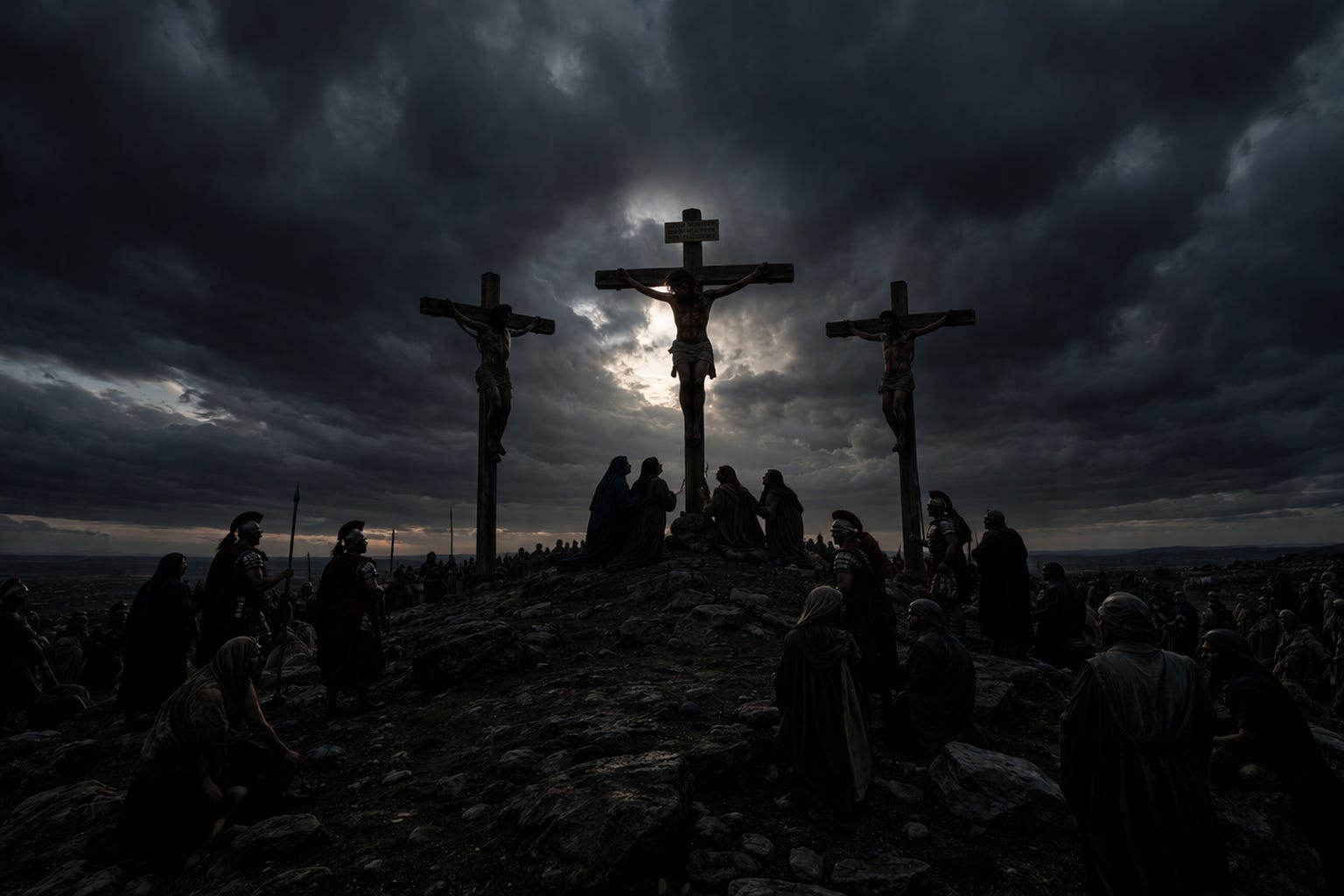
At Golgotha, “the place of the Skull,” Jesus was crucified. It was a busy and brutal scene. He was not the first crucification on this hill, nor would it be the last. The normal rituals were taking place.
The soldiers gambled for His clothing. The crowd grew restless.
Two criminals were crucified beside Him, one on each side.
One mocked Him: “If you are the King of the Jews, save yourself.”
The other saw something different. He said, “Jesus, remember me when you come into your kingdom.”
Jesus replied, “Truly I say to you, today you will be with me in paradise.”
The Women at the Cross
By noon, darkness covered the land. Jesus had been on the cross for three hours.
At the foot of the cross stood His mother, Mary. Mary Magdalene was there, along with other women who had followed Him.
Through pain and exhaustion, Jesus saw His disciple John. As recorded in John 19:27, He said, “Woman, behold your son,” and to John, “Behold your mother.”
From that moment on, John cared for her.
The Final Words
At 3:00 PM, the ninth hour, Jesus cried out and died.
“It is finished.”
These were not words of defeat. They were words of completion.
The work was done. The price had been paid. What began in a garden was now answered on a cross.
To those standing there, it looked like the end. Darkness covered the land. Hope seemed to die with Him. The crowd would soon go home. The noise would fade. The cross would stand silent.
But heaven saw something different.
Justice had been satisfied. Mercy had been extended. The door between God and man, once closed, was now open.
That is why we call it Good Friday.
Not because of what was done to Him, but because of what was done for us.
The innocent died so the guilty could go free.
Barabbas walked away that day, breathing the air of a second chance.
So do we.
The question is not what happened on that Friday.
The question is what we will do with it now. At 3:00 PM, the ninth hour, Jesus cried out and died.
“It is finished.”
These were the final words He spoke before the tomb.
As one theologian wrote, it was the darkest day in human history—and yet, for those who believe, it is called Good Friday.